Ghost Orchid – the making of an immersive audio play
Rachel Pownall
Ghost Orchid is an immersive audio play which was performed for the first time at Burdall’s Yard in Bath as a shared binaural in-headphone event as part of the Bath Digital Festival fringe 2026. Set in a close-knit rural community in the West of England, the play explores how trauma echoes down the generations of a farming family. It explores the themes of belonging, loyalty, and the fragility and resilience of nature.
We wanted to experiment with how well we could create a sense of place and authenticity by recording the audio ambisonically on location. A further layer of immersion was added at the final event by using theatrical elements of set and lighting with the audience listening together while sitting around tables.
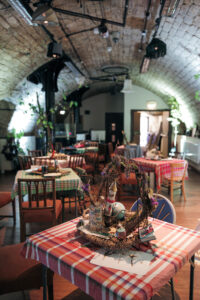
The immersive environment created at Burdall’s Yard. Photo Credit: Edward J Felton
As writer and producer of Ghost Orchid, I was involved all the way through the process from conception to delivery but there was a huge amount of creative input from others, including Liz Felton as director, Jan Meinema as sound designer and Aisha Ali as composer.
Unlike a typical audio play that is recorded in a studio with atmos and sound effects added in post-production, Ghost Orchid was recorded using microphones that record 360 sound, with a full cast on location in a real forest and kitchen. Some specific sound effects, such as thunder, were added later, but during the location recording, the actors moved around the spaces with the microphones picking up the directions of their entrances and exits, and how close or far away they were. The recording schedule was carefully planned so that we recorded in the forest at the correct times of day in order to have the right level and type of birdsong e.g. morning, dusk chorus and nighttime, with the aim of giving the piece authenticity and a real sense of immersion.
I wrote the first draft of Ghost Orchid in the first Covid lockdown when we were only allowed outside for an hour a day during that long, gloriously sunny Spring of 2020. With very little traffic or aeroplane noise, the sound of the birdsong was heightened in the brief periods when I was able to roam around the woods near my home in North Somerset. The play was conceived partly as an antidote to the hatred that was being stirred up by the process of Brexit, but I found the germ of the idea for the story a few months prior to lockdown, when I heard a radio programme that described the extraordinary lifecycle of the European Ghost Orchid.
Further research uncovered a cyclical history of this incredible plant; a young girl or woman would find a bloom by chance when walking in a beech forest. They would often pick the flower or paint it but do no harm to the actual plant, a rhizome living in the root of the tree under which it was found. Later a male botanist would typically hear of their discovery, find the plant and dig it up either to transplant it or just keep it in their collection; either way, the plant would die. Often decades pass between sightings, but the Ghost Orchid, Britain’s rarest plant persists surviving deep in the beech forests.
This struck me as a powerful metaphor for both fragility and resilience. Like many others, I along with some of my female friends and members of our extended families have experienced sexual assault or rape. It is still very much a hidden crime with the vast majority of incidents going unreported and the survivors left to get on with their lives as best they can. Some of these issues are explored through the story of Liz, one of four strong female characters in the play.
Ghost Orchid was originally written as a stage play and performed at the Mission Theatre in Bath as part of SparkFest 2023, produced by Agapanthus Productions. To help with the process of adapting it to an audio piece, Timothy X Atack, was brought in as script consultant. He enabled me to rethink the play as something that was not tied to two locations but could move up and down stairs, in and out of the farmhouse and through the forest. Also, to consider how to alter the framing of some of the visual elements within the stage play, like the Atlas used for pressing flowers, in a way that made sense on an audio level but was not expositional.
Jan Meinema, the sound designer, relished that challenge of recording the piece on location, something that is rarely if ever done with audio dramas. It made the recording process much more complex and expensive, but our hope was that it would also make it much more authentic and immersive. We carried out an initial test record in the Autumn of 2025 outside in a wooded area of the Newton Park Campus at Bath Spa University. Jan used two high quality ambisonic microphones for the main recording plus a set of binaural ears for safety and to give him options in the edit. He also used two lower spec ambisonic mics to record outlying sounds of actors coming and going or whispering comments when hiding in the forest. In addition, each actor had a lapel (lavalier) mic, as back up in case any of the dialogue was not picked up clearly enough. The test record went well and confirmed the superior spatialised quality of the audio when recorded on location.
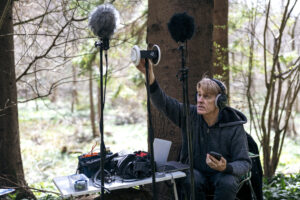
Jan Meinema on location with ambisonic and binaural microphones. Photo credit: Edward J Felton
Initially we considered hiring someone with experience of directing radio dramas for Ghost Orchid but after the test record, we realised that it was important to have someone who understood how to direct actors spatially. Liz Felton, an experienced theatre director and writer, joined in January 2026 as director. She was excited by the idea of working with spatialised audio.
The casting took place in February and early March 2026 and we focused on choosing to cast actors whose voices worked together. For authenticity, where possible, we cast actors who had grown up in the West Country to play the farming family. Rehearsal time was limited to one day with the full cast, and we only had three days to record over one hour of script. It was a very tight turn around for a location audio record and something that would be impossible for a location film shoot. The forest scenes, were recording in some remote woodland outside of Bath. From an audio perspective it was great with very little traffic noise, apart from a few aeroplanes, plus mature woodland, and reasonable access from the road but difficult logistically with no amenities on site.
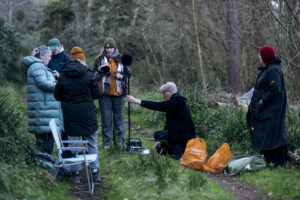
Recording on location in woodland. Photo credit: Edward J Felton
We recorded the interior and farmyard scenes at Bath Spa University’s Corsham Court Campus. We were able to record in a kitchen area but had to cheat scenes like going up and down stairs or in and out of the farmhouse – something that created challenges in the edit. The location was generally very quiet, apart from the peacocks, who were in full voice, and ruined several takes.
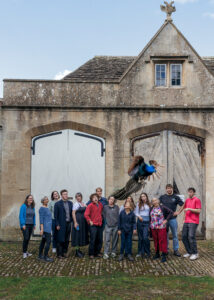
Cast, crew and peacock at Corsham Court. Photo credit: Edward J Felton
While the locations did not have to look real, they had to sound real so we had to provide lots of props including wooden chairs to scrape across a tile floor, keys to drop, a saucepan of ‘soup’ to slurp, biscuits to crunch, kettles to boil and coffee to drink.
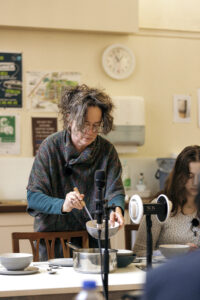
Recording on location at Corsham Court with props. Photo credit: Edward J. Felton
Sound designer, Jan Meinema, and director, Liz Felton, worked together on the editing process. It was incredibly complex, painstaking and time consuming. Cutting in and out of a long take is difficult, but was necessary in order to combine the best audio quality with the best takes, and to ensure the pacing and levels were correct. Sound effects and music also had to be layered in and, critically, the spatialised aspects had to make sense both physically and in terms of the story.
The performances took place at Burdall’s Yard, a small performance venue in Bath with a bar area, gallery and performance space. One of the limitations of creating an in-headphone sharing event was the number of headphones available. We had 26 headphones linked to silent disco-style receivers, which limited the audience numbers for each performance, so we chose to do three events across one day. We had one day prior to the performances to set up all the tech and create and dress the set. Naomi Smyth’s concept for the set was to create a mix of forest and farmhouse with place settings on each table giving clues to the personalities and back stories of the different characters within the play. The lighting by Isabel Potter helped differentiate between the forest and farmhouse locations and indicate time of day.
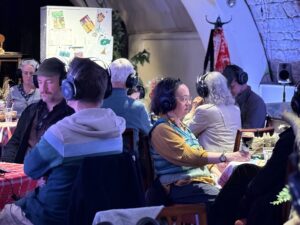
Audience listening to Ghost Orchid at Burdall’s Yard. Photo credit: Elizeta Pylioti
We were unsure how the audience would react to this unusual blend of theatre and listening event, so, as part of the research, a survey was conducted after the performances. The audience feedback was very positive in terms of how immersive they found the piece with 92.5% feeling that they were inside the world of the play, and 95% that the recorded elements (the woods, the farmhouse) felt like real places. The response to it being an in-headphone shared experience was more mixed with 55% saying they would have preferred to listen on their own at home. However, 80% thought that the set and lighting in the room helped them into the world of the play and only 15% thought listening with other people detracted from their experience. 100% said they would come to another listening event like this.
Going forward, we hope to tour Ghost Orchid to small rural venues in the West Country with a pared back set and lighting. Trialing an ambisonic version of the play using a speaker rig with people listening together without headphones is also an option. This project was very much an experiment, being as far as I am aware, a unique blend of shared binaural in-headphone narrative experience within an immersive theatrical setting. I was very happy with the authenticity the spatiaised location recording brought to the audio, with how the set and lighting complemented the experience and with the audience response. It has opened my ears to the possibilities of using spatialised sound in storytelling, and I am keen to experiment more with it in the future.
Ghost Orchid was commissioned by Dr Ruth Farrar, of Bath Spa University, as part of the Immersive Audio research strand within the MyWorld, a large multi-partner UKRI, Strength in Places funded programme to promote the innovative use of creative technology across the Bath and Bristol area, in association with Agapanthus Productions. For a full list of cast and crew please follow this link: Ghost Orchid – immersive audio play – The Studio
Related posts
Micro-mapping Apartheid: Archives, Stories and AR
We are two academics who met in Cape Town when our children became friends. Conversations around our shared interests in history, technology and Cape Town’s District Six got us sp...
We are two academics who met in Cape Town when our children became friends. Conversations around our shared interests in history, technology and Cape Town’s District Six got us sp...
Leaving Space at the Table
Democracy is starting to feel uncomfortable. In 2016, we saw the rise of the ‘silent majority’ with Trump, Brexit, and the return of One Nation. In the most recent Australian elect...
Democracy is starting to feel uncomfortable. In 2016, we saw the rise of the ‘silent majority’ with Trump, Brexit, and the return of One Nation. In the most recent Australian elect...
AI and Creative Writing Practice Webinar
From generative writing tools to augmented publishing processes, artificial intelligence is rapidly changing and challenging the landscape of creative writing and publishing. To re...
From generative writing tools to augmented publishing processes, artificial intelligence is rapidly changing and challenging the landscape of creative writing and publishing. To re...
Five Things I Learned from Episodic
There were a lot of things to like about the Episodic conference that took place in London in October. Run by the Storythings team, it featured a range of interesting speakers work...
There were a lot of things to like about the Episodic conference that took place in London in October. Run by the Storythings team, it featured a range of interesting speakers work...
What3words as a storytelling technology in Pin the Tale
What3words is a tool that allows you to communicate your location – wherever you are on earth – using three words. It is backed by a geolocation system that has divided the world i...
What3words is a tool that allows you to communicate your location – wherever you are on earth – using three words. It is backed by a geolocation system that has divided the world i...
Being Water: Ocean Media and the Milieus of Writing with AI
This article is part of a series focused on how artificial intelligence is being used as a tool for writing for the screen and stage as well as how it is depicted on screen and sta...
This article is part of a series focused on how artificial intelligence is being used as a tool for writing for the screen and stage as well as how it is depicted on screen and sta...