What3words as a storytelling technology in Pin the Tale
Jack Lowe
What3words is a tool that allows you to communicate your location – wherever you are on earth – using three words. It is backed by a geolocation system that has divided the world into 3m x 3m squares and given each one a unique three-word address.
The idea behind what3words is that it is much easier to share your location using three words compared to other geolocation systems, such as GPS, which involve listing lots of numbers separated by dots and commas.
This means that, in an emergency, you could tell responders your location more quickly and precisely. Other suggested use cases include pointing delivery drivers to the correct entrances for large buildings, or helping people create designated meeting places at music festivals.
Most people’s experience of what3words, however, will be looking up the 3-word address for where they live and being amused by the odd combination of words that they’re shown.
This amusement reveals something important: that the words used in what3words addresses aren’t empty signifiers. They have meaning, and when combined and used to refer to places, our response to those addresses reveals something about how we see the world.
Pin the Tale takes this observation one step further. It is an online game that encourages players to write stories about places in the UK using their what3words addresses, pinning them to a digital map. It involves deliberately playing with the associations that what3words addresses have and thinking about their relationships with the places they refer to.
Stories on Pin the Tale must include all three words in the what3words address of the place being written about. They can be up to 300 words in length, and writers must include a photograph taken at the location, alongside a short hint that describes the place in plain English.
Once stories have been added to the platform, other users can read them and attempt to identify their exact locations. After they put a correct what3words address in a story’s answer box, the story is added to their collection.
As the game’s creator, I’ve been able to observe the unique ways this system affects the processes of creative writing and storytelling, the kinds of stories told and how they connect to the places in question.
In this article, I’m going to talk about some trends I’ve noticed in how people write stories with Pin the Tale, and what we can learn from these observations about the affordances of what3words as a storytelling tool.
From description to juxtaposition
The first thing to note is that the words in each what3words address have no deliberate link to the place they are attached to, instead being determined arbitrarily by an algorithm.
This lack of context makes the words feel ‘random’, and part of the amusement we often get from reading 3-word addresses is the obscurity of the word combinations themselves, and the fact that these weird groups of words have been linked to places we’re familiar with.
What’s happening here is juxtaposition: a process of putting elements side-by-side, where you are invited to consider the relationship between them. In this case, juxtaposing the individual words with each other, and the combination of words with the place.
Occasionally, you can find places where the words seem particularly apt (for example, a bench in Canterbury where one word in its what3words address is ‘bench’) and 3-word addresses that fit well together in a sentence or seem to suggest a narrative. But most of the time the words have no obvious connection to each other or the place to which they’re attached.
What does this mean when you attempt to write site-specific stories with them?
Well, creative writing already makes ample use of techniques where the words being used do not literally describe the thing you’re writing about.
Imagery – the use of similes and metaphors to help paint a picture in the reader’s mind – is a prime example.
Idioms are another example: sayings or turns-of-phrase used to express common sentiments, that often cannot be easily understood without being familiar with the cultural context in which they’re expressed.
Given the lack of literal connections between 3-word addresses and their locations, it is perhaps no surprise that many contributors to Pin the Tale are drawn to styles of writing that are more figurative.
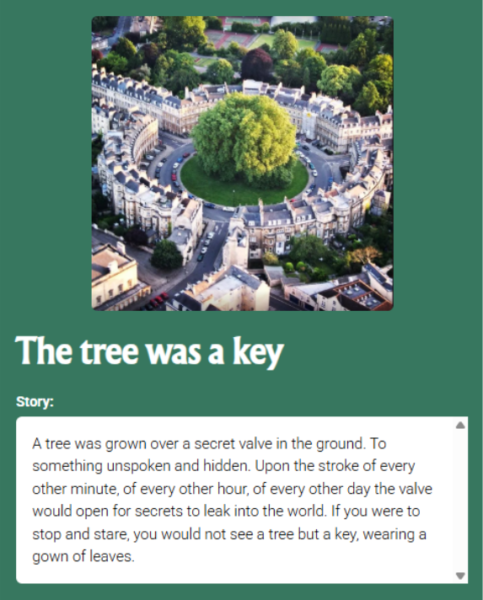
Pin the Tale story written using the words ‘valve’, ‘minute’ and ‘gown’.
The story above uses the words ‘valve’ and ‘minute’ to craft a fantasy about its location in Bath, inspired by the true history of the architect John Wood, who designed the road layout to look like a key from above. The third word, ‘gown’, is used metaphorically to describe how the tree’s leaves appear as if they are cloaking a secret.
Poetic forms are also commonly employed by writers on Pin the Tale.
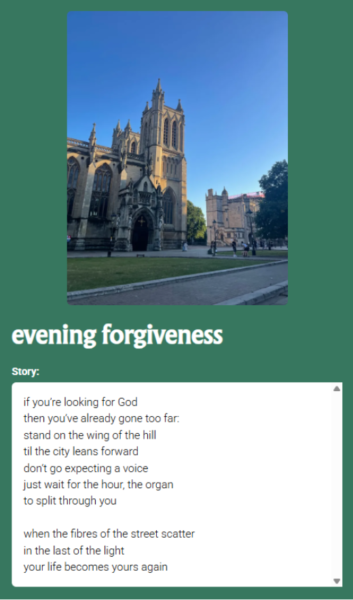
Pin the Tale story written using the words ‘leans’, ‘wing’ and ‘organ’.
In the example above, two of the address words – ‘leans’ and ‘wing’ – are metaphors that conjure an image of a person’s position in relation to the city. The rest of the poem is crafted around the core theme of a spiritual resonance that can exist between a single human and a place at a particular time.
What we can say, then, is that writing with what3words often inspires a turn from the literal to the figurative; from description to juxtaposition. Contributors to Pin the Tale employ a style of writing that is typically less factual and on-the-nose, but rather evokes the relationships between things, and particularly how they pertain to the places being written about.
Shifts in perspective
Many people approach the task of writing with what3words by thinking about a place that is meaningful to them in some way. Then they look at the 3-word address for their chosen spot and think “How on earth am I going to fit these words in?” The words simply don’t align with their understanding of what is significant about the place, even if they try thinking more figuratively.
Sometimes, the words are just too oddly specific to make them work in the context of your narrative. It’s going to be hard to write a story that includes words like ‘crouton’, ‘peroxide’, ‘gearbox’ and ‘megawatt’ unless the tale you’re telling happens to relate to those specific things.
Another common culprit is verbs. Verbs used in what3words addresses can be conjugated in all sorts of ways, and it is surprising how challenging it can be to include a verb that is in a different person or tense to the one you intended to write in.
How do you overcome these constraints?
The solution that many Pin the Tale players have adopted is to write their story from a different perspective.
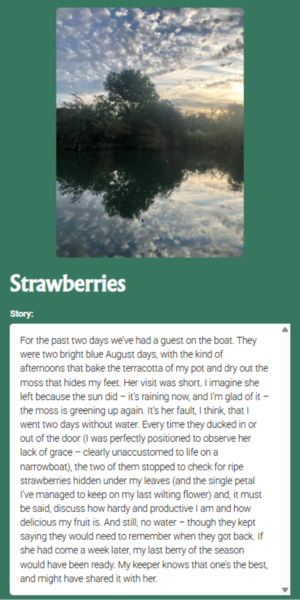
Pin the Tale story written using the words ‘petal’, ‘ready’ and ‘short’.
In the above example, the word ‘petal’ led the author to write a story about a friend visiting their canal boat from the perspective of a strawberry plant. The details contained within the narrative have a different quality when described from this point of view. The weather, and the sense of expectation around the fruit, become driving forces in the story. And in my reading, they interestingly convey the complexities of timing in adult friendships.
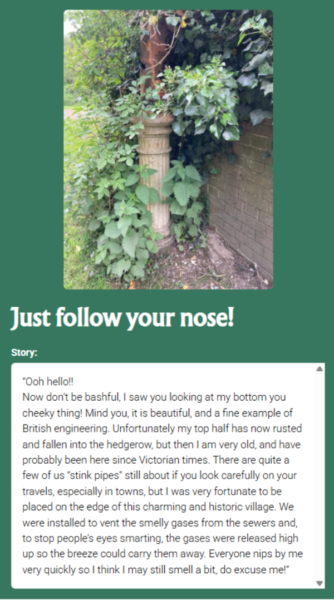
Pin the Tale story written using the words ‘nips’, ‘smarting’ and ‘bashful’.
In ‘Just follow your nose!’, with one of the three words being ‘nips’ – a verb in the third person – it becomes difficult to talk about the stinkpipe from the first-person perspective of a human observer saying that they ‘nip past it’. By telling the story from the perspective of the object, the human becomes the third person described by the verb. And it gives the author the opportunity to personify the stinkpipe in an entertaining yet informative way.
Players often tell me that it is more difficult to come to Pin the Tale with a particular story in mind that you want to write. When you do approach the task this way, it can become a tactical process of finding ways to shoehorn your given words into a narrative you have already mapped out. Or alternatively, if your chosen place is covered by more than one what3words square, finding an address with words that are easier to fit into your story.
By letting your story be shaped by the given words, you go from thinking about what a place means to you, or what a place is commonly known for, to a sense of what it could mean: to a different person or entity, in a different context. The words change your perspective.
Jumping-off points
What we can begin to see from these observations is that writing with what3words has a peculiar effect of revealing relations between things, perhaps more than the things themselves. If you’re going to make sense of the significance that three arbitrary words might have for a place, then you’re going to have to find some kind of connection between them, whether that is based on material reality or imagination.
What’s exciting about this process is that different people will perceive completely different connections between the same sets of words in the same places.
I recently ran a poetry workshop using Pin the Tale, where one of our activities was to write a collaborative poem about a chosen place using its what3words address. It was fascinating how the different attendees interpreted the task. One person wrote about their memory of meeting a friend in the place. Another person imagined the place as the epicentre of a future political uprising. Other attendees wrote about a wide variety of things that you can physically find there.
It’s for this exact reason that Pin the Tale allows multiple stories to be pinned to the same what3words square. Even within such a small area, with the same combination of words, the range of potential associations is vast.
One of the most common pieces of feedback I get from players is that the game’s constraints are a source of inspiration. Having to include the three words in your story means that you aren’t starting from a blank sheet. Instead, there is already a jumping-off point; something for writers to connect to and branch out from in their own unique ways.
Extend this writing process over an entire city, or a country, and you can imagine the rich tapestry of stories that can be woven. Click on the Find Stories button when you first load up Pin the Tale – when the map shows the whole of the UK – and you will see what I mean. The platform’s stories are highly varied.
Both in the writing of stories and in how they are engaged with by readers, the platform provides geolocated jumping-off points through which narrative connections can be established. The interface extends your scope from the individual event, the individual thing, person or character, to their significance as part of the wider storied tapestry that we understand as a place.
A tool for connection
What3words is a technology with a particular set of characteristics. Firstly, it is a geolocation system that points to 3m x 3m spaces on the earth’s surface. Secondly, this geolocation system uses sets of three words: real words that have existing meanings to people. Thirdly, these word combinations are arbitrary: the words within each 3-word address do not have any intentional link with each other or the location with which they’re associated.
When adopted for storytelling in Pin the Tale, this system has particular affordances. As writers attempt to bring the geolocated word combinations into a meaningful structure – a narrative – what3words addresses become jumping-off points; inspirational constraints used to reveal and make connections between a wide range of site-specific things. Juxtaposition and playing with perspective are two examples of relational methods that writers use to create unique pieces of storytelling out of the address words.
Writing, and storytelling in particular, are often said to forge connections between disparate people and contexts. This is their superpower. In its use of the what3words system, Pin the Tale’s interface is designed to centre place as a hotbed of such connections. To show how places allow you to go beyond yourself; to think about all the other lives that have been, are being and will be lived in that locality.
Related posts
Transmedia Storytelling and Activism
2020 and 2021 have left all of us (except, perhaps, Elon Musk and Jeff Bezos) living with more uncertainty and vulnerability than we have allowed ourselves to admit previously. Li...
2020 and 2021 have left all of us (except, perhaps, Elon Musk and Jeff Bezos) living with more uncertainty and vulnerability than we have allowed ourselves to admit previously. Li...
What Right to Write These People?
The interior northwestern United States is remote: impenetrable mountains, untamed rivers, and disorienting prairies paired with unpredictable and extreme weather. Once an intricat...
The interior northwestern United States is remote: impenetrable mountains, untamed rivers, and disorienting prairies paired with unpredictable and extreme weather. Once an intricat...
Words: Foundation Bricks in a Media Warehouse
The creation, presentation and publication of new creative work has been a core element of undergraduate teaching programs at Queensland University of Technology for over four deca...
The creation, presentation and publication of new creative work has been a core element of undergraduate teaching programs at Queensland University of Technology for over four deca...
Will AI Destroy Great Writing?
Is a still image generated by artificial intelligence a photograph, a snapshot of what the AI tool ‘sees’ online, or is it something else entirely? Can the copyright of a film scri...
Is a still image generated by artificial intelligence a photograph, a snapshot of what the AI tool ‘sees’ online, or is it something else entirely? Can the copyright of a film scri...
Developing Lotus, A Meditative Story App
It can be scary to look back sometimes, almost like a fear of heights. It's six years ago (six years!) that I first started thinking about the project that was just r...
It can be scary to look back sometimes, almost like a fear of heights. It's six years ago (six years!) that I first started thinking about the project that was just r...
My Creative Collaborator
This article by Nadim Sadek, author and Founder & CEO of Shimmr AI, is one of a series commissioned as part of MyWorld, a UKRI-funded project that explores the future of creati...
This article by Nadim Sadek, author and Founder & CEO of Shimmr AI, is one of a series commissioned as part of MyWorld, a UKRI-funded project that explores the future of creati...